
EV breaker troubleshooting • Loganville, GA

EV Charger Trips the Breaker in Loganville, GA

A breaker that trips when charging begins is shutting the circuit down for a reason. The useful question is not simply whether the breaker is “bad,” but whether the trip is being caused by the circuit, charger settings, a connection problem, the charging equipment, or the vehicle.

Do not repeatedly reset it. If you notice heat, a burning odor, discoloration, buzzing, or a breaker that will not remain set, turn the charging circuit off if it is safe to do so and arrange an electrical inspection.
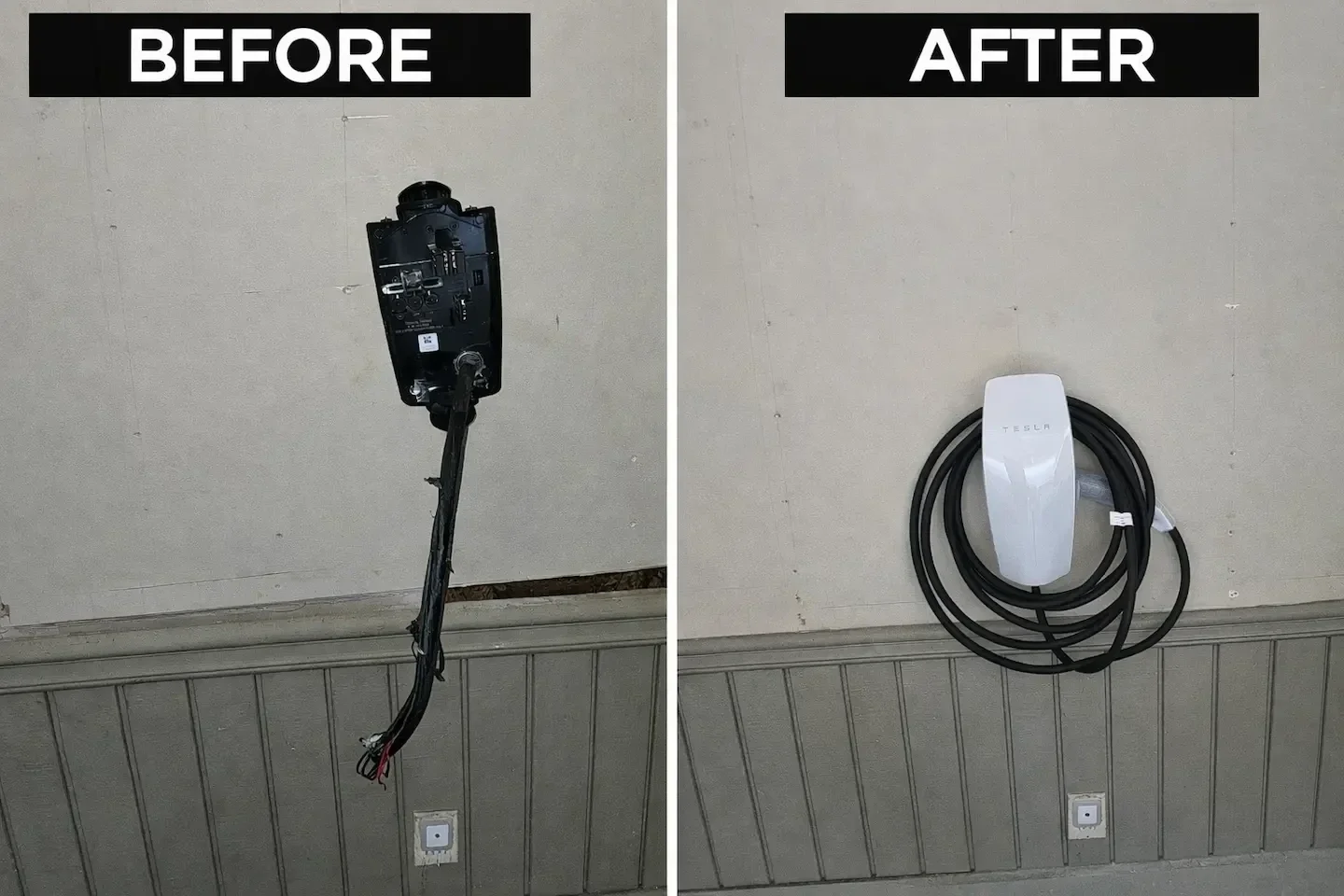
Before and after EV charging project completed by Kais Pro Repairs in Loganville Georgia
A completed Loganville EV charging project by Kais Pro Repairs.
Trip-timing diagnosis What happens before, during, and after charging begins provides different clues.
House-versus-vehicle isolation Testing should separate a branch-circuit problem from a charger or vehicle fault.
Local field experience Residential electrical and EV charging service in Loganville and nearby communities.
Start with the symptom

Did the breaker trip, or did the charger only stop charging?

Those are different faults and should not be treated as the same search problem.

This page applies when the circuit breaker physically moves to the tripped position or opens the circuit during a charging attempt. If the breaker remains on but the charger displays a warning, turns red, or will not deliver power, use our guide to an EV charger that is powered but not charging.

For a charger that changes from blue to red after the vehicle connects, the light pattern and manufacturer fault code can provide additional clues. See our explanation of an EV charger that turns blue and then red.

Trip-timing guide

When the breaker trips changes what should be tested

Timing does not prove the cause, but it helps an electrician decide where to begin instead of replacing parts at random.

What happens Possible categories Useful information to record
Trips before the car begins charging Branch-circuit fault, damaged conductor, ground fault, charger hardware issue, or an incorrect connection. Whether the car was connected, charger light pattern, recent installation or repair work, and any visible damage.
Trips as charging current ramps up Incorrect output setting, weak or incompatible breaker, loose termination, circuit problem, charger fault, or vehicle-side fault. Breaker rating, charger amperage setting, vehicle model, fault code, and how quickly the trip occurs.
Trips after several minutes Heat developing at a connection, damaged equipment, breaker problem, conductor issue, or charging output that does not match the installed circuit. Approximate charging time before the trip and whether any component feels or smells unusually hot. Do not remove the panel cover.
Trips only when other large loads run Service or panel capacity concern, load interaction, voltage issue, or a separate electrical problem that becomes visible under combined load. Which appliances were operating, time of day, charger output, and whether other circuits were affected.
Trips or faults with only one vehicle Vehicle charging hardware, charge-port condition, communication issue, or a fault that appears only during that vehicle's charging sequence. Whether the vehicle charges successfully on a known-good public or portable charger and whether another vehicle works at the home charger.

A larger breaker is not a troubleshooting shortcut. Breaker size, conductor ampacity, wiring method, charger output, equipment instructions, and available panel capacity must agree. Read our 50-amp versus 60-amp EV charging comparison before assuming that a higher breaker rating is the answer.

Field example • Loganville, Georgia

A charging fault that did not end with another breaker swap

One Loganville diagnostic call involved an Emporia Level 2 charger and a Kia EV9. The case shows why house-side and vehicle-side evidence must be compared before recommending more electrical work.

Charging equipment Emporia Level 2 charger
Vehicle Kia EV9
Installed circuit 50-amp circuit with #6/3 copper NM-B
Reported charger warning Seven-flash ground-fault indication

What changed the direction of the diagnosis

  • The charging cable and breaker were replaced during the troubleshooting process.
  • Neutral and equipment-ground separation in the panel was verified.
  • The vehicle also failed to charge successfully from a public charger.
  • The portable 120-volt charging equipment did not provide a successful comparison charge.

The combined evidence shifted the next step away from replacing more home electrical parts and toward vehicle-side evaluation. That conclusion belonged to this specific job; a different home can produce a similar symptom for a completely different reason.

Structured troubleshooting

How we isolate an EV charging breaker trip

The order matters. Each step should narrow the cause before a repair or equipment change is recommended.

1

Identify the exact event

We confirm whether the breaker actually trips, when it happens, what the charger displays, and whether the symptom began after an installation, setting change, repair, or vehicle change.

2

Match output to the circuit

We compare the charger configuration with the breaker, conductors, wiring method, equipment rating, and manufacturer requirements. The largest setting is not automatically the correct setting.

3

Inspect connections and equipment

We look for heat, discoloration, loose or damaged terminations, incorrect breaker hardware, conductor damage, and problems at the charger or receptacle. Learn why the connection choice matters in our hardwired versus plug-in charger guide.

4

Observe the circuit under load

When safe and appropriate, we evaluate voltage, current, trip timing, charger behavior, and signs of heat as charging begins. A circuit can appear normal at idle and fail only under sustained load.

5

Evaluate panel capacity

Open breaker spaces do not prove that the electrical service can support the requested charging load. If capacity is the real limitation, review the options on our electrical panel upgrade page.

6

Separate home from vehicle

Charger fault codes, comparison charging, another compatible vehicle, and the sequence of failure help determine whether the evidence remains house-side or points toward the vehicle.

Before the appointment

Send the details that make diagnosis faster

  • Charger brand and exact model
  • Vehicle year, make, and model
  • Clear photo of the charger and any fault light or code
  • Photo of the breaker label with the panel cover left in place
  • Current charger-output setting, if visible in the app
  • Whether the trip is immediate, delayed, or tied to other household loads
  • Whether the vehicle charges successfully anywhere else

What not to do

  • Do not install a larger breaker just to stop the trip.
  • Do not keep resetting a breaker that trips again.
  • Do not open the electrical panel to take photos.
  • Do not continue using a hot or discolored receptacle, plug, or charger.
  • Do not assume an open breaker space means the home has enough capacity.

If you are planning a new circuit instead of troubleshooting an existing one, start with our Level 2 EV charger installation service.

Homeowner questions

EV charger breaker-trip FAQs

Can I replace the tripping breaker with a larger breaker?

No—not as a shortcut. The breaker must protect the installed conductors and match the wiring method, charger configuration, equipment instructions, and circuit design. Upsizing only the breaker can remove protection that the existing wiring depends on.

Why does the breaker trip only after the charger runs for a while?

A delayed trip can be associated with heat developing at a connection, a breaker problem, conductor or equipment damage, or charging output that does not match the installed circuit. The timing is useful evidence, but the circuit still needs to be inspected and tested.

Should a charger be set to the same amperage shown on the breaker?

Not usually. EV charging is a continuous load. Common configurations limit charging to 40 amps on a 50-amp circuit or 48 amps on a 60-amp circuit when the charger, conductors, wiring method, panel capacity, and complete installation support that output.

Can the vehicle cause the charging circuit to trip?

It is possible. If the symptom follows one vehicle across multiple known-good charging sources while another compatible vehicle works at the home charger, the evidence may point toward the vehicle. That comparison should be considered alongside circuit and charger testing.

Do I automatically need a panel upgrade?

No. A panel upgrade should be recommended only when the panel condition, capacity, service limitations, equipment requirements, or final circuit design justify it. A breaker trip by itself does not prove that the whole panel must be replaced.

Field content from Kais Pro Repairs. Prepared from residential electrical and EV charging troubleshooting experience and reviewed in August 2026. Learn more about Kais Pro Repairs or view our recent electrical work.

Need an EV breaker-trip diagnosis in Loganville?

Call or text with the charger model, vehicle, breaker size, fault code, and the point at which the trip occurs. Kais Pro Repairs serves Loganville and nearby communities across Walton and Gwinnett counties. For other residential electrical needs, visit our Loganville electrician page.