

50 Amp vs 60 Amp EV Charger Installation: Which One Is Right?
A 60 amp EV charger circuit may sound better than a 50 amp circuit, but the right answer depends on your charger, your electrical panel, the wire, the installation method, and a proper load calculation.
The biggest mistake homeowners make is choosing a 50 amp or 60 amp EV charger circuit based only on what someone online said. The better question is this: what can your charger use, what can your panel safely support, and what installation method is correct for your home?
50 amp vs 60 amp EV charging, explained clearly.
These are the practical numbers homeowners usually need before comparing estimates or choosing a charger setting.
- 50 amp circuit: commonly supports up to 40 amps of continuous EV charging, or about 9.6 kW at 240 volts.
- 60 amp circuit: commonly supports up to 48 amps of continuous EV charging, or about 11.5 kW at 240 volts.
- 80% continuous-load rule: EV charging runs for long periods, so the charging current is generally limited to 80% of the circuit breaker rating.
- Actual charging speed: the vehicle and charger can limit output below the circuit maximum. A larger breaker alone does not force faster charging.
- Panel capacity: an open breaker space does not prove the service can support the new load. A load calculation is still needed.
- Final design: conductor ampacity, wiring method, distance, temperature, equipment instructions, permits, and local requirements can change the correct installation.
50 amps is enough for many homes. 60 amps can be better when the whole setup supports it.
A 50 amp circuit and a 60 amp circuit are not the same installation. The difference affects charging current, breaker size, wire requirements, installation method, panel capacity, and sometimes the total project cost.
When a 50 amp EV charger circuit may make sense
A 50 amp circuit is common for many Level 2 EV charging setups. Because EV charging is a continuous load, a 50 amp circuit commonly supports up to 40 amps of charging, or about 9.6 kW at 240 volts, when the equipment and installation are rated correctly.
This can be a good fit when the homeowner does not need the fastest possible charging, the charger is limited to a lower output, or the panel does not have enough available capacity for a larger circuit.
When a 60 amp EV charger circuit may make sense
A 60 amp circuit commonly supports up to 48 amps of continuous charging, or about 11.5 kW at 240 volts, when the EV charger is designed for it, the wiring method is correct, and the electrical panel can safely support the added load.
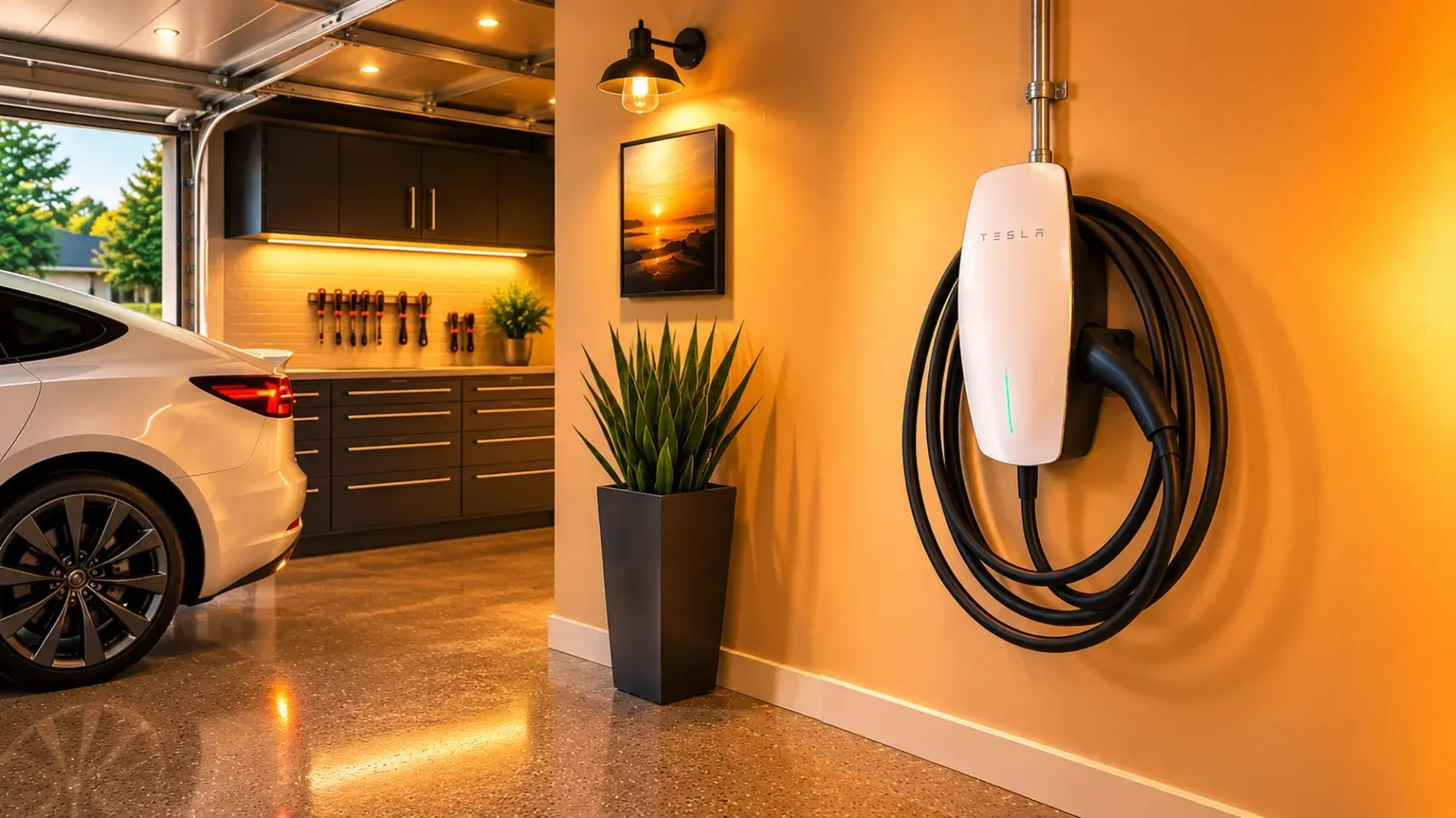
For a Tesla Wall Connector, a 60 amp hardwired circuit can be a strong option when the panel passes the load calculation and the homeowner wants the fastest practical home charging setup.
The circuit size is only one part of the decision.
This comparison gives homeowners a practical overview. The final answer still depends on the charger, vehicle, electrical panel, wire type, installation method, and local code requirements.
| Item | 50 Amp Circuit | 60 Amp Circuit |
|---|---|---|
| Typical continuous charging output | Often up to about 40 amps, depending on the charger and setup. | Often up to about 48 amps, depending on the charger and setup. |
| Common use | Good for many Level 2 EV charging needs. | Better when the charger can use the higher output and the home can support it. |
| Installation method | May be hardwired or may involve a properly rated receptacle, depending on the charger and design. | Commonly hardwired for chargers like the Tesla Wall Connector when configured for higher output. |
| Panel requirement | Still needs panel review and proper load calculation. | Needs an even closer panel capacity check because the load is higher. |
| Best homeowner fit | Homeowners who want reliable Level 2 charging without necessarily pushing maximum output. | Homeowners who want faster practical home charging and whose panel, charger, and wiring support it. |
Important: EV charging is a continuous electrical load. Breaker size, wire size, wiring method, charger settings, and load calculation all matter. Do not simply install a larger breaker because you want faster charging.
How much EV charging speed do you really need?
Before choosing between a 50 amp and 60 amp EV charger circuit, it helps to think about how you actually use the vehicle. The fastest setup is not always necessary for every homeowner. The right setup is the one that safely matches your driving habits, your charger, your panel capacity, and your budget.
If you drive short distances daily
If most of your driving is local, a 50 amp circuit may provide more than enough charging for daily use. Many homeowners simply need the vehicle to recover overnight so it is ready the next morning.
In this situation, paying more for the highest possible charging output may not always be necessary.
If you drive longer distances
If you drive long distances, use the vehicle heavily, or need faster overnight recovery, a 60 amp hardwired setup may be worth considering when the charger and electrical panel can safely support it.
This is where a proper load calculation becomes important before deciding on the final circuit size.
If you want the best long-term setup
Some homeowners choose a stronger setup because they want better charging flexibility now and in the future. That can make sense, but only when the charger, wire size, panel capacity, and installation method are all correct.
A bigger circuit should be a planned decision, not a guess.
The goal is not just faster charging. The goal is safe, reliable charging.
A 60 amp circuit can be a good option when the whole setup supports it, but a properly installed 50 amp circuit can also be the right answer for many homes. The best choice depends on how much charging you actually need and what your electrical system can safely handle.
A bigger breaker does not always mean faster charging.
A breaker is not a speed upgrade by itself. The charger, vehicle, wire, conduit or cable type, panel capacity, and charger output setting all have to match the circuit.
Many homeowners assume that installing a larger breaker automatically makes the EV charger charge faster. That is not how a safe EV charger installation works.
Charging speed depends on the charger rating, the vehicle’s onboard charging limit, the circuit size, the wiring method, and the charger setting after installation.
Do not upsize a breaker unless the entire circuit is designed for it.
If the wire, charger, or panel cannot safely support the larger load, a bigger breaker creates a safety problem instead of a better charging setup. The correct breaker protects the wire and equipment. It should not be used to force more charging power out of an installation that was not designed for it.
Do I need a panel upgrade for an EV charger?
Not every EV charger installation requires a panel upgrade, but some homes do need one. The answer depends on the home’s existing electrical load, the panel size, the charger output, and whether the electrical system has enough available capacity.
You may not need a panel upgrade if...
You may need a panel upgrade if...
Open breaker spaces do not prove the panel can handle an EV charger.
A panel can have physical room for a breaker and still lack enough electrical capacity for a 50 amp or 60 amp EV charger circuit. That is why the panel should be checked before choosing the final charger size.
Hardwired vs plug-in EV charger: why it matters.
After choosing the circuit size, the next question is whether the charger should be hardwired or installed with a receptacle. This decision affects the installation method, the parts used, the finished look, and the charger output options.
Hardwired EV charger
A hardwired charger is connected directly to the circuit without a plug and receptacle. This is often the cleaner and stronger option for higher-output chargers, especially when the charger is designed to be installed that way.
For some setups, hardwiring can reduce extra connection points and allow the charger to be configured for higher output when the panel, wire, and charger all support it.
Plug-in EV charger
A plug-in charger uses a properly rated receptacle. This can be useful when the homeowner wants flexibility, but the receptacle, breaker, wire, box, GFCI requirements, and charger rating still have to be correct.
A plug-in setup should not be treated like a regular household outlet. EV charging is a continuous load and needs the correct electrical design.
Common EV charger installation mistakes.
Many EV charger problems start before the charger is ever mounted on the wall. The wrong assumptions can lead to tripping breakers, poor charging performance, overheated wiring, failed inspections, or an installation that does not match the homeowner’s needs.
Choosing the breaker first
The breaker size should be based on the charger, wire, panel capacity, and installation method. It should not be chosen first just because the homeowner wants faster charging.
Ignoring the load calculation
EV charging adds a serious continuous load. Installing the charger without checking the panel can create nuisance tripping or overload problems.
Using the wrong wiring method
Wire size, conduit, cable type, distance, and installation conditions matter. A 50 amp setup and a 60 amp setup may require different design decisions.
Setting the charger too high
Some chargers allow output adjustments. If the charger is configured higher than the circuit can safely support, the installation can become unsafe.
Buying the charger before checking the home
Homeowners sometimes buy a charger before confirming whether the panel, route, wiring method, and desired output make sense for the house.
Treating EV charging like a normal outlet
EV chargers run for long periods. That makes the circuit design more important than a typical outlet installation.
Before you choose 50 amps or 60 amps, check the full setup.
This quick decision checklist helps homeowners understand why the correct EV charger installation is based on more than the breaker size.
Decision Checklist
Driving habits
A homeowner who drives short distances may not need the same charging speed as someone who drives heavily every day.
Charger capability
The charger must be able to use the circuit size. A bigger breaker does not help if the charger cannot use the extra output.
Panel capacity
Open breaker space is not enough. The panel needs enough available capacity for the EV charger load.
Wire and route
A short garage run is different from a long basement-to-garage run through finished walls, ceilings, or conduit.
Hardwired or plug-in
The installation method affects the finished look, connection points, charger options, and electrical requirements.
Future needs
If the homeowner may add another EV later, future capacity should be discussed before the first charger is installed.

Tesla Wall Connector installed from a basement panel to the garage.
This homeowner had been using the standard 120V charger, but it was not charging the vehicle fast enough for their needs. They wanted a Tesla Wall Connector in the garage, but they were unsure whether a 50 amp or 60 amp circuit was the right choice.
The homeowner wanted faster charging.
The 120V charger worked, but it was too slow for the homeowner’s daily use. They wanted a Level 2 charging setup that made the vehicle more practical to own.
The panel had physical space, but that was not enough.
The electrical panel had room for a breaker, but breaker space alone does not prove the panel can safely handle the added EV charging load. A load calculation was performed before choosing the final circuit size.
The panel passed the load calculation.
After checking the panel capacity, the Tesla Wall Connector, and the homeowner’s goal for faster home charging, a 60 amp circuit was selected.
The charger was hardwired with #6 wires in conduit.
Kais Pro Repairs installed a hardwired Tesla Wall Connector using #6 wires in conduit. The run was approximately 50 feet from the basement panel up to the garage.
The result was a cleaner, faster home charging setup.
The homeowner got the faster practical charging setup they wanted, but the decision was not based on guessing. It was based on charger capability, panel capacity, wire method, and the load calculation.
Do not choose the breaker size first. Choose the correct installation.
The right EV charger setup starts with the home, not the internet. A safe installation looks at the full electrical picture before deciding between 50 amps and 60 amps.
Your charger matters
Not every charger uses the same output. Some chargers are designed for lower amperage. Others, like a Tesla Wall Connector, may be configured for higher output when installed correctly.
Your panel matters
Open breaker space does not automatically mean your panel has enough available capacity. EV charging adds a serious continuous load, so the panel needs to be checked properly.
Your wiring method matters
Wire size, conduit, cable type, distance, and installation conditions all affect the final design. A 60 amp hardwired circuit is not the same as a basic receptacle installation.
The money-saving move is not always the smaller circuit. The smart move is the correct circuit.
A cheaper EV charger installation can become expensive if the wrong breaker is installed, the panel is overloaded, the charger is configured incorrectly, or the wiring method does not match the load.
Before installing your EV charger, the full setup needs to be evaluated.
A proper EV charger installation is more than mounting the charger on the wall. The electrical system needs to support the load safely.
Electrical checks before installation
Common problems this helps prevent
Do not install a bigger breaker just because you want faster charging.
The breaker is not a speed upgrade by itself. The wire, charger, panel capacity, installation method, and charger configuration all have to match. A bigger breaker on the wrong wiring is not an upgrade. It is a safety problem.
Practical answers before you install an EV charger.
These are the questions homeowners should ask before choosing between a 50 amp and 60 amp EV charger circuit.
Is a 60 amp EV charger circuit always better than a 50 amp circuit?
No. A 60 amp circuit is only better when the charger can use it, the wiring method is correct, and the electrical panel can safely support the added load. Some homes are better suited for a 50 amp setup, while others can support a 60 amp hardwired charger.
What does the 80% rule mean for EV charger circuits?
EV charging is treated as a continuous electrical load. A continuous load is generally limited to 80% of the circuit breaker rating, which means a 50 amp circuit commonly supports up to 40 amps of charging and a 60 amp circuit commonly supports up to 48 amps when the equipment, conductors, installation method, and panel capacity are all suitable.
Can a 50 amp EV charger circuit provide 48 amps of continuous charging?
No. A 50 amp branch circuit is generally limited to 40 amps of continuous EV charging. A charger configured for 48 amps normally requires a properly designed 60 amp circuit and compatible hardwired equipment.
Can I tell if my panel can handle an EV charger just by looking for open breaker spaces?
No. Open breaker spaces help, but they do not prove the panel has enough available electrical capacity. A load calculation is the proper way to check whether the panel can safely support the added EV charging circuit.
Why hardwire a Tesla Wall Connector instead of using a plug-in outlet?
A hardwired installation is often the cleaner and stronger option for higher-output EV charging. For a Tesla Wall Connector on a 60 amp circuit, hardwiring is commonly the practical choice when the home and panel support it.
How much does a 50 amp or 60 amp EV charger installation cost?
The cost depends on the panel location, route distance, wiring method, charger type, wall construction, conduit needs, and whether the panel has enough capacity. A short garage run is different from a longer basement-to-garage installation. Call Kais Pro Repairs for a free EV charger estimate.
Need help choosing between a 50 amp and 60 amp EV charger?
Call Kais Pro Repairs for a free EV charger estimate. We can check your panel, review your charger, discuss your charging goals, and help you choose the right installation for your home. For local coverage details, visit our Walton County electrical service page.