

Breaker Keeps Tripping? Do Not Keep Resetting It.
A breaker that keeps tripping is not something to ignore. It can point to an overloaded circuit, loose wiring, a bad breaker, a ground fault, an arc fault, moisture, or an appliance pulling more power than the circuit can safely handle.
Kais Pro Repairs helps homeowners find the real cause of nuisance tripping before the problem gets worse. We troubleshoot the circuit, inspect the panel, check the devices, and explain the safest repair option clearly.
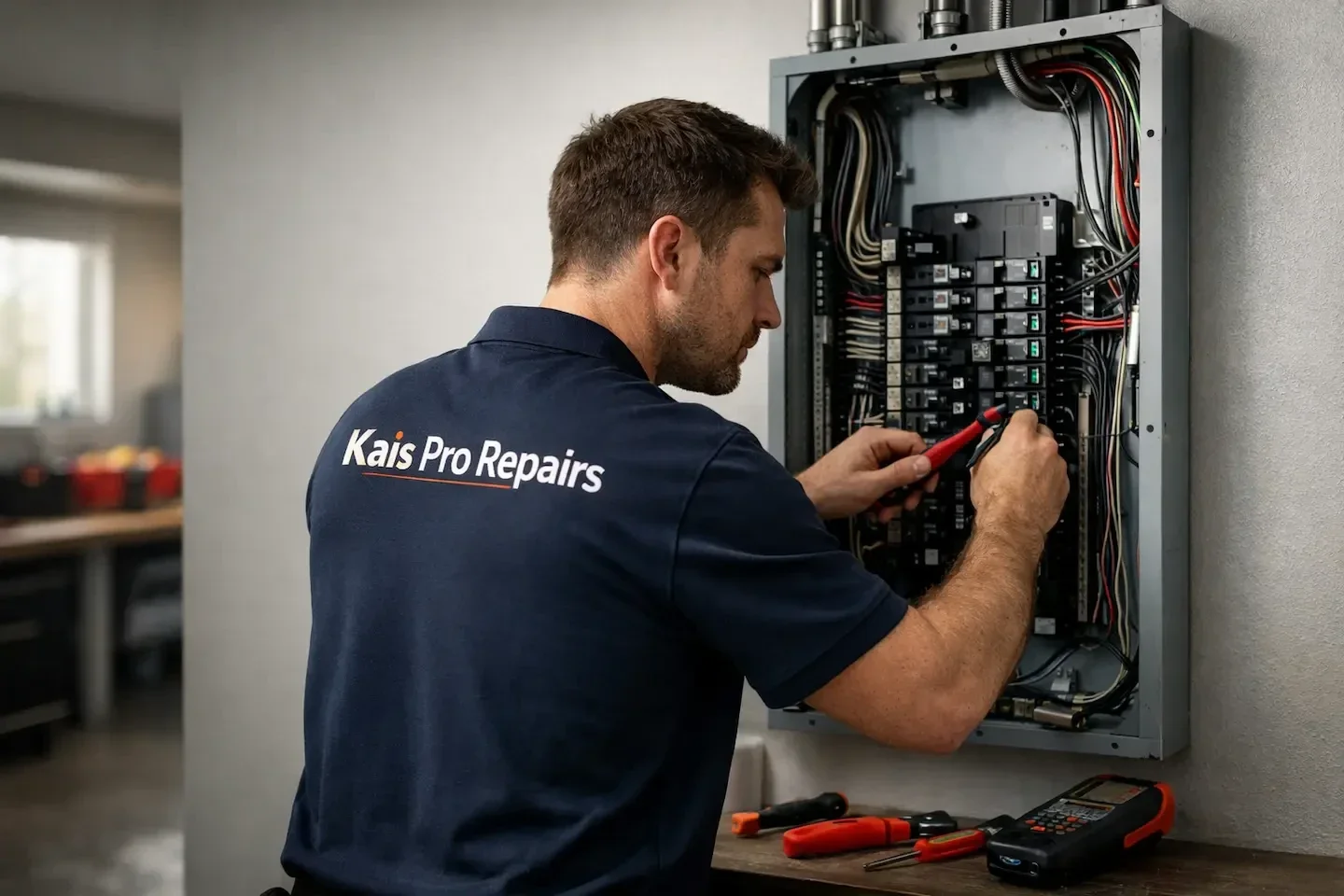
What Is Nuisance Tripping?
Nuisance tripping is when a breaker trips repeatedly and the homeowner cannot see an obvious reason. The dangerous mistake is assuming the breaker is simply “bad” without checking the circuit.
Sometimes the breaker is worn out. But many times, the breaker is doing exactly what it was designed to do: shutting off power because something on the circuit is unsafe or overloaded.
The blunt truth: a tripping breaker is a warning, not an inconvenience.
If a breaker keeps opening the circuit, something is causing it. Resetting it over and over without finding the cause can hide a serious issue, especially if the problem involves heat, damaged wiring, loose connections, moisture, or current leakage.
Overloaded Circuit
Too many high-demand devices on the same circuit can overload the breaker. Space heaters, microwaves, hair dryers, toasters, vacuums, and window AC units are common causes.
Faulty Appliance
If the breaker trips only when one appliance runs, the issue may be inside the appliance or with how that appliance interacts with the circuit.
Loose or Damaged Wiring
Loose terminals, damaged insulation, overheated devices, backstabbed outlets, or chewed wiring can all create breaker tripping problems that need proper electrical troubleshooting.
Why Your Breaker Keeps Tripping
The tripping pattern matters. A breaker that trips instantly points to a different problem than a breaker that trips after an appliance has been running for ten minutes.
| What You Notice | Possible Cause | What It Usually Means |
|---|---|---|
| Breaker trips immediately when reset | Short circuit, ground fault, damaged wiring, failed device, or failed breaker | The circuit should be checked before it is used again. |
| Breaker trips when a specific appliance starts | Appliance issue, motor startup load, overloaded circuit, or weak breaker | The appliance and circuit both need to be evaluated. |
| AFCI breaker trips randomly | Arc fault detection, loose connection, shared neutral issue, damaged cord, or incompatible equipment | The breaker may be detecting an unsafe arc or wiring condition. |
| GFCI breaker trips repeatedly | Ground fault, moisture, appliance leakage, damaged cord, or wiring issue | The circuit is sensing current leakage and needs proper testing. |
| Breaker trips after running for a while | Overload, heat buildup, failing breaker, or high continuous load | The load may be too much for the circuit or the breaker may be deteriorating. |
| Breaker trips with nothing plugged in | Hidden wiring issue, hardwired load, outdoor device, moisture, or damaged cable | Do not assume nothing is connected. Something may still be on that circuit. |
Related service: circuit breaker repair and replacement.
AFCI and GFCI Breakers Can Trip for Different Reasons
Modern safety breakers are more sensitive because they are designed to detect problems that older standard breakers may not catch. That is good for safety, but it also means the diagnosis has to be sharper.
AFCI Breaker Keeps Tripping
AFCI breakers are designed to detect dangerous arcing conditions. If an AFCI breaker keeps tripping, the cause may be a loose connection, damaged cord, old device, shared neutral problem, incompatible equipment, or actual arcing somewhere on the circuit.
Replacing the breaker without testing the circuit is guessing. The smarter move is to inspect the wiring, devices, connections, and loads first.
GFCI Breaker Keeps Tripping
GFCI breakers are designed to detect current leaking where it should not go. Moisture, damaged appliance cords, outdoor equipment, pool equipment, garage loads, washing machines, or EV chargers can trigger GFCI protection.
If a GFCI breaker trips repeatedly, do not bypass the protection. Find the fault.
If the issue involves an EV charger, see our related guide on EV chargers not charging in Loganville, GA. If you are deciding between charger circuit sizes, read 50 amp vs 60 amp EV charging.
What Homeowners Can Safely Check Before Calling
You can do a few simple checks before calling an electrician. Do not remove panel covers, open electrical boxes, or touch wiring unless you are trained and qualified.
Unplug Recent Devices
If the problem started after adding a new appliance, heater, treadmill, freezer, charger, or tool, unplug it and see if the tripping pattern changes.
Look for Moisture
Outdoor outlets, garages, basements, crawlspaces, and exterior equipment can trip GFCI protection when moisture gets into boxes, cords, devices, or equipment.
Notice the Pattern
Write down when the breaker trips. Does it happen instantly, after a few minutes, when the washer starts, when lights turn on, or when it rains?
Do not keep resetting a breaker that trips immediately.
If the breaker trips instantly or repeatedly, stop using that circuit and call an electrician. A breaker is a safety device. Forcing it back on does not fix the problem.
How Kais Pro Repairs Troubleshoots Nuisance Tripping
We do not walk in and automatically sell a breaker replacement. The job is to prove what is causing the trip. That is how you protect the home and avoid unnecessary repairs.
We Identify the Circuit and Trip Pattern
We check what the circuit serves, when the breaker trips, what changed recently, and whether the problem is tied to one appliance or the entire circuit.
We Inspect the Panel and Breaker
We look for heat damage, loose terminations, incorrect breaker type, damaged equipment, improper wiring, panel condition, and signs that the breaker may be failing.
We Test Devices, Loads, and Wiring Conditions
Depending on the issue, we may check outlets, switches, GFCI devices, AFCI circuits, appliances, outdoor equipment, and wiring continuity.
We Recommend the Correct Fix
The solution may be a breaker replacement, device replacement, load separation, wiring repair, GFCI/AFCI correction, panel repair, or a dedicated circuit for a high-demand appliance.
If your panel is older, crowded, damaged, or no longer keeping up with your home’s electrical demand, review our page on electrical panel upgrades.
When a Breaker Replacement Makes Sense
Sometimes the breaker is the problem. But replacing it without checking the circuit is lazy troubleshooting. A breaker replacement makes sense when testing supports it.
Possible Signs of a Bad Breaker
- Breaker feels weak or loose
- Breaker will not stay reset with no load connected
- Breaker shows heat damage or discoloration
- Breaker trips below expected load after testing
- Breaker is old, worn, or mechanically failing
When the Circuit May Be the Real Issue
- Tripping happens only with one appliance
- Tripping happens during rain or humidity
- Outlets or switches feel warm
- Lights flicker before the trip
- Breaker trips instantly when reset
The right repair is the one proven by the troubleshooting.
A breaker that keeps tripping may need a new breaker, a wiring repair, a new outlet, a corrected GFCI/AFCI issue, a dedicated appliance circuit, or panel work. The wrong repair wastes money and leaves the real issue behind.
Related Electrical Services
Breaker tripping is often connected to other parts of the home’s electrical system. These related pages help homeowners understand the bigger picture.
Circuit Breaker Services
For worn breakers, damaged breakers, overloaded circuits, and breaker panel issues.
Electrical Panel Upgrades
For older, crowded, damaged, or undersized panels that cannot safely support modern electrical demand.
EV Charger Troubleshooting
For Level 2 chargers, breaker trips, ground fault codes, and charger faults.
50 Amp vs 60 Amp EV Charging
Compare charging speed, breaker size, wire size, and panel capacity before installing a Level 2 charger.
Loganville Electrician
Local residential electrical service for troubleshooting, repairs, panels, lighting, outlets, and EV chargers.
Contact Kais Pro Repairs
Need the breaker checked? Request a free estimate and describe what is tripping.
Need a Breaker Troubleshooting Electrician in Loganville, GA?
If your breaker keeps tripping, do not waste time guessing. Kais Pro Repairs helps homeowners in Loganville and nearby areas troubleshoot nuisance tripping, overloaded circuits, AFCI/GFCI issues, faulty breakers, loose wiring, and electrical panel problems.
Service Areas
Kais Pro Repairs serves homeowners in Loganville, Snellville, Grayson, Lawrenceville, Monroe, Lilburn, Duluth, Walton County, and Gwinnett County.
Main local page: electrician in Loganville, GA.
Frequently Asked Questions About Breakers That Keep Tripping
These are common questions homeowners ask when a breaker keeps tripping and the cause is not obvious.
Why does my breaker keep tripping?
The most common reasons are an overloaded circuit, faulty appliance, short circuit, ground fault, arc fault, loose wiring, moisture, or a failing breaker. The trip pattern helps determine the likely cause.
Is it safe to keep resetting a tripped breaker?
No. If a breaker trips once, you can reset it after checking for an obvious overload. If it keeps tripping, stop resetting it and have the circuit checked. The breaker may be preventing overheating, arcing, or another unsafe condition.
Can a bad breaker cause nuisance tripping?
Yes, a weak or failing breaker can trip when it should not. But the circuit should be checked before assuming the breaker is bad. Replacing the breaker without finding the cause can leave the real problem in place.
Why does my AFCI or GFCI breaker keep tripping?
AFCI breakers can trip from arcing, loose connections, damaged cords, shared neutral problems, or incompatible equipment. GFCI breakers can trip from current leakage, moisture, damaged appliances, outdoor equipment, or wiring faults.
Do I need an electrician if the breaker only trips sometimes?
Yes, especially if the problem keeps coming back. Intermittent tripping can still be caused by heat buildup, a loose connection, appliance failure, moisture, or a hidden wiring issue.
Can a washing machine, refrigerator, or EV charger trip a breaker?
Yes. Appliances with motors, heating elements, compressors, electronics, or charging equipment can trip breakers when there is an overload, leakage current, startup issue, wiring problem, or breaker compatibility issue.