

What Should I Know Before Installing an EV Charger?
Installing a home EV charger gives you faster charging, better convenience, and less dependence on public charging stations. But before you add a charger to your garage or driveway, your home’s electrical system needs to be checked the right way.
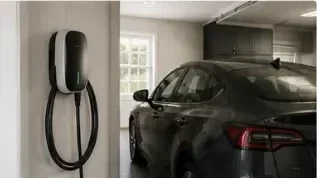
A home EV charger is not just another outlet.
A Level 2 EV charger is a high-demand electrical load. It needs the correct breaker, wire size, panel capacity, mounting location, and charger settings. If those details are ignored, you can end up with nuisance tripping, overheating, failed charging, or an installation that needs to be redone.
If you are comparing charger sizes, also read our guide on 50 amp vs. 60 amp EV charging.
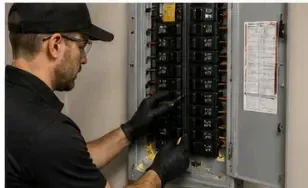
Start with your electrical panel.
Before installing an EV charger, the first question is simple: can your electrical panel safely support it? An open breaker space does not automatically mean your panel has enough available capacity.
- Main panel size
- Available breaker space
- Existing electrical load
- Panel condition
- Whether a load calculation or panel upgrade is needed
If your panel is already heavily loaded, you may need electrical corrections before the charger is added. Kais Pro Repairs can inspect your setup and explain your options clearly.
Know the difference between Level 1 and Level 2 charging.
Level 1 charging uses a regular 120-volt outlet. It is slow and may be fine for light driving, but many homeowners quickly outgrow it.
Level 2 charging uses 240 volts and is the better choice for most homeowners who want reliable daily charging. It charges much faster and is usually the setup people want when they ask for a home EV charger.
For dedicated EV charger installation, visit our EV charger installation service page.
The breaker, wire, and charger settings must match.
This is where many bad EV charger installations go wrong. The breaker size, wire size, charger rating, and charger output setting all need to work together.
If the charger is set too high for the circuit, the breaker may trip or the wiring may be pushed beyond what it should safely handle. If the breaker is oversized for the wire, that is a serious safety problem.
If your breaker trips after installation, the problem may be the charger setting, the circuit sizing, the breaker, the wiring, or a ground-fault issue.
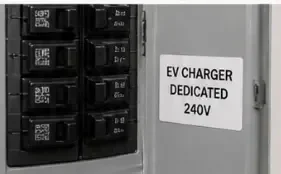
Use a dedicated circuit.
A home EV charger should usually be installed on its own dedicated circuit. That means it should not share the circuit with garage outlets, freezers, lights, tools, or other equipment.
Sharing an EV charger circuit can cause nuisance tripping, slow charging, overheating concerns, or repeated service calls. EV chargers pull power for long periods, so the circuit should be planned for that load.
If you are having breaker issues, see our circuit breaker repair and replacement service.
Pick the charger location carefully.
Charger location affects how easy the charger is to use every day. Before installation, think about where you park, where the vehicle charging port is located, how long the charger cable is, and how far the charger will be from the panel.
A good installation should look clean, keep the cord manageable, and avoid placing the charger where it can be hit, stretched, or exposed to unnecessary damage.
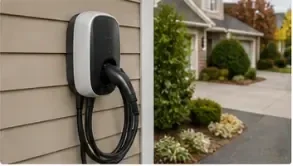
Outdoor installations need extra protection.
If the charger is installed outdoors, it must be suitable for the location and protected from weather, water entry, physical damage, and poor mounting conditions.
Outdoor EV charger installations may require proper conduit, weather-rated equipment, secure fittings, and a location that makes sense for the driveway or parking area.
Do not ignore charger faults or nuisance tripping.
If your EV charger keeps tripping the breaker, flashes red, stops charging, or works one day and fails the next, do not keep resetting the breaker and hoping it goes away.
The issue may be a bad breaker, incorrect charger setting, loose connection, grounding problem, damaged wire, panel issue, or a fault inside the charger or vehicle charging system.
Repeated tripping is not just annoying. It is information. The circuit is telling you something needs to be diagnosed.
The cheapest EV charger installation is not always the best one.
A rushed installation can leave you with tripping breakers, undersized wiring, poor charger placement, messy conduit, or a panel that was never properly evaluated. The better question is not only “how much does it cost?” The better question is: “Can my home safely support this charger, and will the installation be done correctly?”
What should a proper EV charger installation include?
A professional EV charger installation should include a panel review, proper circuit sizing, correct wire and breaker selection, secure mounting, clean workmanship, correct charger setup, and final testing before regular use.
EV Charger Installation
Need a Level 2 charger installed? View EV charger services.
Panel Upgrades
If your panel is full or overloaded, see our electrical panel upgrade service.
Loganville Electrician
For local electrical service, visit our Loganville electrician page.
EV Charger Planning FAQs
What should I check before buying a home EV charger?
Before buying a charger, check your vehicle’s maximum Level 2 charging rate, where you park, the distance from the electrical panel, whether the charger will be indoors or outdoors, and whether your panel has enough capacity for a new dedicated 240V circuit.
Should I choose the EV charger before calling an electrician?
You can choose the charger first, but it is smarter to confirm your panel capacity and installation path before buying one. Some chargers require different circuit sizes, hardwired connections, or outdoor-rated installation details.
Where is the best place to mount a home EV charger?
The best location is usually close to where you park, within easy reach of the vehicle’s charging port, protected from damage, and practical for the wiring path from the electrical panel.
Should my EV charger be hardwired or plugged into a 240V outlet?
It depends on the charger, the amperage, the installation location, and your long-term charging needs. Hardwired chargers are common for higher-output setups, while 240V outlet setups may work for some plug-in chargers when installed correctly.
What can make an EV charger installation cost more?
Cost can increase when the charger is far from the panel, the panel is full, conduit is needed, the installation is outdoors, wall or attic access is difficult, or a panel upgrade or subpanel is required.
Need EV charger installation in Loganville, GA?
Kais Pro Repairs installs Level 2 EV chargers for homeowners in Loganville, Snellville, Lawrenceville, Grayson, Monroe, and nearby areas. We check the panel, size the circuit correctly, and complete a clean, safe installation.