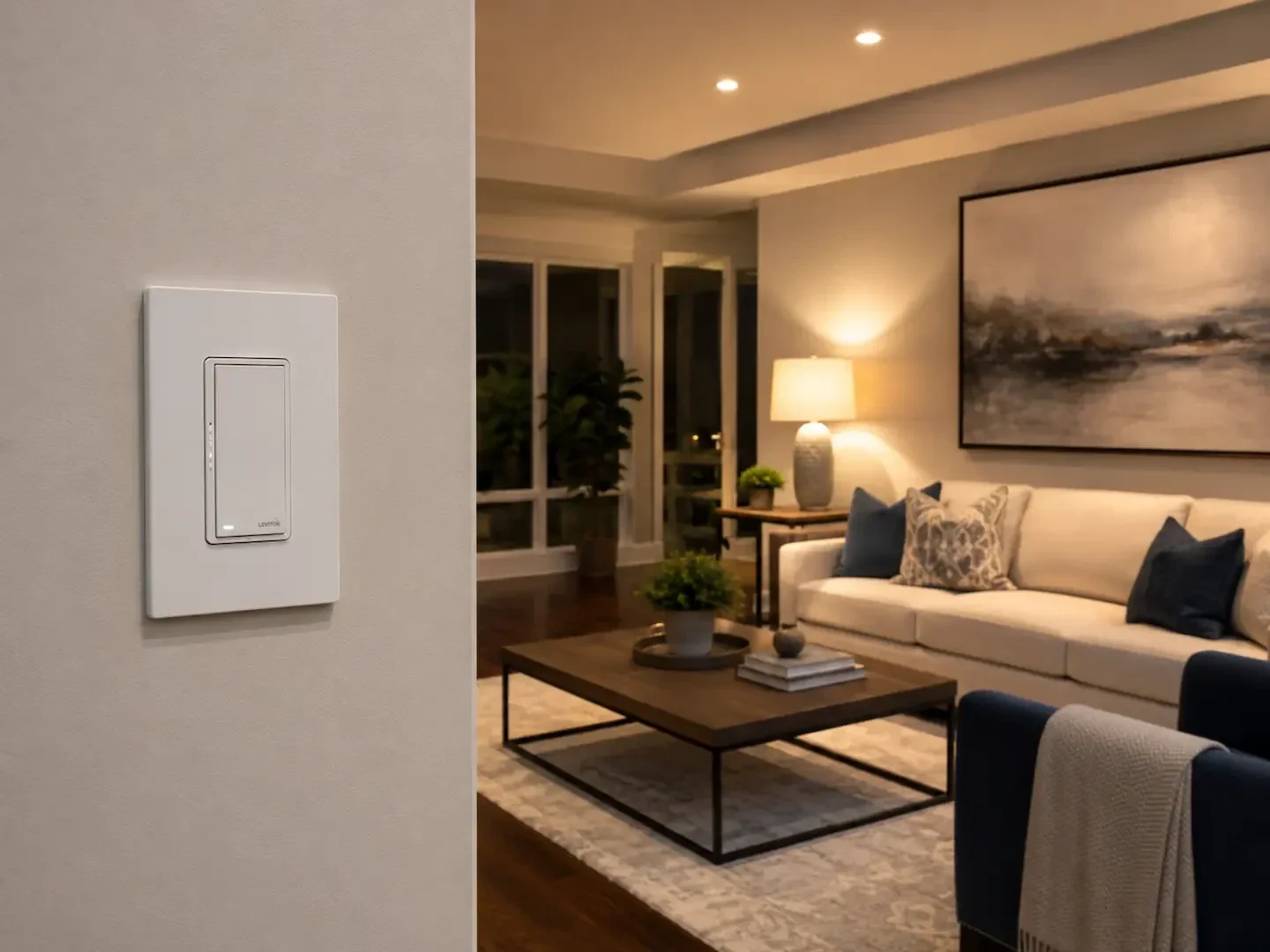
Leviton smart switch installed in a modern living room with warm lighting

Smart Switches for Home Lighting Control

Smart switches let homeowners control lights, ceiling fans, and selected fixtures from the wall, phone app, schedule, voice assistant, or smart home system. The right smart switch can make a home easier to use, safer when you are away, and cleaner than relying on plug-in timers.

The important part is choosing the correct type of smart switch for the wiring in the wall. Neutral wires, three-way circuits, dimming compatibility, ceiling fan loads, box space, and Wi-Fi signal strength all matter before the switch is installed.

Remote Control Turn lights on or off from your phone when the setup supports app control.
Schedules and Timers Automate porch lights, garage lights, security lighting, and vacation lighting.
Cleaner Than Plug-In Timers Wall-mounted control keeps the setup neat and easy for the whole home to use.
Wiring Must Match Neutral, line, load, traveler, ground, and load type must be checked before installation.

What Is a Smart Switch?

A smart switch is a wall switch that replaces a standard light switch and adds connected control. You can still press it at the wall, but you may also control it from a phone app, schedule, voice assistant, or smart home platform.

A regular switch simply opens and closes the circuit. A smart switch does that too, but it also contains electronics that need power so the device can stay connected, remember settings, communicate with the app, and respond to schedules or commands.

The switch box matters before the smart switch brand.

The mistake many homeowners make is buying the smart switch first and checking the wiring later. Some boxes do not have a neutral wire. Some boxes are crowded. Some three-way circuits are wired differently than expected. Some switches control ceiling fans, not just lights.

Before installing a smart switch, the box should be checked for the correct wiring, proper depth, safe connections, and compatibility with the light or fan being controlled.

How It Works

How a Smart Switch Works in a Home

A smart switch controls power to the light or fan like a normal wall switch, but it also uses a small amount of power to stay connected to your home network or smart-home system.

Wall Control

The switch still works manually. Anyone in the home can press the switch without needing an app, password, or voice command.

App and Schedule Control

The smart switch can turn lights on or off from an app, run on a schedule, or follow routines like sunset, sunrise, bedtime, or vacation mode.

Smart Home Control

Many smart switches can work with systems such as Alexa, Google Home, Apple Home, SmartThings, Lutron, Leviton, Kasa, and similar platforms when compatible.

Benefits

Benefits of Smart Switches for Homeowners

Smart switches are not just a gadget. Used correctly, they solve real homeowner problems: dark entryways, forgotten lights, hard-to-reach switches, vacation security, and rooms where several lights need easier control.

Control Lights From Anywhere

Turn selected lights on or off from your phone when you are at work, out of town, upstairs, downstairs, or pulling into the driveway.

Improve Home Security

Use schedules or vacation mode to make the home look occupied instead of leaving the same light on all day and night.

Make Daily Routines Easier

Set porch lights, kitchen lights, garage lights, landscape lighting, or hallway lights to turn on and off automatically.

Reduce Forgotten Lights

Schedules and app control help prevent lights from staying on all day because someone forgot to turn them off before leaving.

Add Voice Control

When compatible, smart switches can work with voice assistants so homeowners can control lights without walking across the room.

Keep the Wall Switch Useful

Unlike some smart bulbs, a smart switch keeps the wall control functional. The light can still be controlled the way guests and family expect.

Types of Smart Switches

Different Types of Smart Switches and Where They Make Sense

The best smart switch depends on what the existing switch controls, how the circuit is wired, and what features the homeowner wants. A smart dimmer, smart fan control, three-way smart switch, and standard on-off smart switch are not the same device.

Smart Switch Type Best Use What to Check First
Single-pole smart switch One switch controls one light or group of lights from one location. Line, load, neutral, ground, box space, and total fixture load.
Three-way smart switch Two switches control the same light, such as stairs, hallways, kitchens, or garages. Traveler wires, common wire, neutral location, and whether a companion switch is required.
Smart dimmer switch Lights where brightness control matters, such as kitchens, dining rooms, living rooms, bedrooms, and recessed lighting. LED dimming compatibility, minimum load, neutral requirements, and whether the bulbs are dimmable.
Smart fan control Ceiling fans where speed control or app control is desired. Whether the switch is rated for fan motor loads. A light dimmer should not be used as a fan speed control.
No-neutral smart switch Older switch boxes where a neutral wire is not present. Brand requirements, bulb compatibility, minimum load, hub requirements, and whether the existing wiring supports the device.
Motion or occupancy smart switch Bathrooms, laundry rooms, garages, closets, pantries, and utility areas where lights are often left on. Sensor location, room layout, neutral wire, load type, timeout setting, and whether manual override is needed.
Smart relay or module Special cases where the existing switch style needs to remain or where the control device fits behind the switch. Box space, heat, wiring layout, device rating, and whether future service access will be reasonable.
Connection Types

Wi-Fi, Hub-Based, Z-Wave, Zigbee, and Matter Smart Switches

Smart switches can connect in different ways. The connection type affects setup, reliability, app control, voice control, and how many devices the home network can handle.

Wi-Fi switches connect directly to the home network. Hub-based systems use a bridge or hub. Z-Wave and Zigbee devices usually communicate through a hub. Matter is a newer smart-home standard designed to improve compatibility across ecosystems, but the exact experience still depends on the device and platform being used.

Simple rule: match the switch to the home, not the other way around.

  • Large homes may need stronger network coverage or a hub-based system.
  • Older homes may need no-neutral options or wiring corrections.
  • Dimmed LED lights need compatible smart dimmers and dimmable bulbs.
  • Ceiling fans need fan-rated smart controls, not standard light dimmers.
  • Three-way locations need the correct smart switch and companion setup.
Best Locations

Where Smart Switches Are Most Useful

The highest-value smart switch locations are the lights homeowners use every day, the lights they forget to turn off, and the lights that make the home safer or easier to enter at night.

Porch and Exterior Lights

Set outdoor lights to turn on around sunset and off in the morning without depending on someone remembering the switch.

Garage and Entry Lights

Control lights when arriving home, unloading groceries, parking at night, or walking into a dark garage.

Kitchen and Main Living Areas

Use smart dimmers or schedules for the rooms used most often, especially where several lights need easy control.

Hallways and Stairs

Three-way smart switches can improve control in areas where multiple switch locations already exist.

Bedrooms

Control lights from the bed, set routines, or use dimming where compatible with the fixture and bulbs.

Vacation Lighting

Schedule lights to turn on and off while traveling so the home does not look empty.

Installation Warning

Common Smart Switch Mistakes Homeowners Should Avoid

Smart switch installation can look simple, but the wiring behind the wall decides whether the switch will work safely and reliably.

If the wrong wire is used as neutral, line and load are reversed, the traveler wires are misidentified, the device is not rated for the load, or the box is too crowded, the result can be flickering, switch failure, tripping, overheating, or a setup that never connects properly.

Check these before installing a smart switch

  • Is there a neutral wire in the switch box?
  • Is the switch single-pole, three-way, four-way, or part of a multi-gang box?
  • Does the switch control lights, a ceiling fan, an outlet, or mixed loads?
  • Are the LED bulbs compatible with the smart dimmer?
  • Is there enough box space for the smart switch body and wiring?
  • Is the breaker tripping or is there another electrical problem that should be corrected first?

Read the Grayson AFCI breaker tripping case study

Smart Switches vs Smart Bulbs

Smart Switches Are Usually Better for Permanent Lighting Control

Smart bulbs have their place, but smart switches are usually cleaner for rooms where the wall switch is the normal way people control the light.

Smart Switches

Better for permanent fixtures, exterior lights, recessed lights, ceiling lights, and rooms where the wall switch needs to keep working normally.

Smart Bulbs

Useful for lamps, color-changing lights, or rooms where each bulb needs separate control, but they can become annoying if someone turns off the wall switch.

Best Setup

Use smart switches where the switch controls the room, and use smart bulbs where color control or individual bulb control is the goal.

Local Service Area

Smart Switch Help Near Loganville, GA

Kais Pro Repairs helps homeowners with smart switch installation, smart dimmers, three-way smart switches, ceiling fan controls, lighting controls, switch troubleshooting, and lighting upgrades in Loganville, Snellville, Grayson, Lawrenceville, Monroe, Between, Gwinnett County, and Walton County.

Homeowner Questions

Smart Switch Questions Homeowners Ask Before Buying

These questions help homeowners avoid buying the wrong smart switch for the wiring, fixture, or control setup in the home.

A smart switch is a wall switch that controls a light, ceiling fan, or fixture like a normal switch, while also allowing control from an app, schedule, voice assistant, or smart home system when compatible.

Many smart switches need a neutral wire because the device needs constant power for its electronics. Some no-neutral smart switches are available, but the switch box should be checked before buying.

Yes, but three-way smart switch setups usually require the correct master switch and companion switch. The common wire, traveler wires, neutral, line, and load need to be identified correctly.

Only if the device is designed for fan control. A regular smart light switch or smart dimmer should not automatically be used on a ceiling fan motor.

Most smart switches can still turn the light on and off at the wall. App control, remote access, and some automations may not work until internet service or the home network returns.

Use smart switches for permanent room lighting where the wall switch needs to keep working normally. Use smart bulbs when color control or individual lamp control is the priority.

Smart Switch Installation

Before You Buy the Smart Switch, Check the Box

Send photos of the switch box, the light or fan being controlled, and the smart switch you want to install. Kais Pro Repairs can help identify whether the setup needs a neutral-required switch, no-neutral model, companion switch, smart dimmer, fan control, or a different wiring approach.