

Electrical Safety Guide for Loganville Homeowners
Can I Replace a 15-Amp Breaker With a 20-Amp Breaker?
Short answer: No—not as a shortcut for a tripping breaker. A 20-amp breaker should not protect an ordinary residential branch circuit containing 14-gauge copper wiring. A conversion is appropriate only after the entire circuit is verified or rebuilt for 20-amp service.
A breaker protects the wiring, not just the appliance that happens to be plugged in. If it trips, the cause should be investigated rather than bypassed with a higher rating.
Why Replacing the Breaker Is Not the First Step
A circuit breaker can open because of an overload or an electrical fault. Those conditions require diagnosis, not automatic upsizing. Conventional breakers use magnetic action for high-current faults and thermal action for sustained overcurrent; their operating time depends on both the amount of current and how long it continues. See the U.S. Consumer Product Safety Commission’s explanation of residential circuit-breaker operation.
A higher breaker rating does not increase the capacity of wiring already concealed in walls, attics, boxes, or devices. It changes the level of overcurrent protection. That is why the conductor size and condition must be established before the breaker rating is changed.
Real Loganville-Area Service Call: A Tripped 20-Amp Breaker and Burned 14-Gauge Wiring
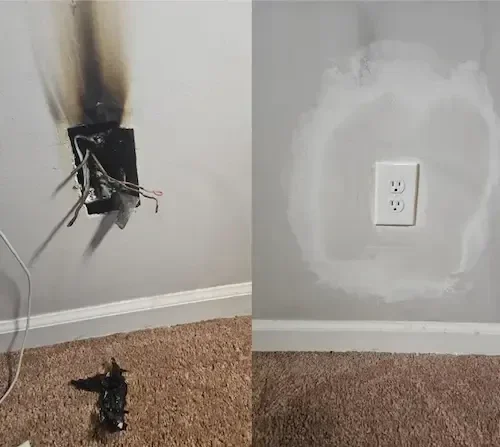
On this service call, a portable air conditioner had been used on the affected branch circuit. When we arrived, the circuit was no longer operating normally: the 20-amp breaker was tripped and the wiring at the outlet was burned.
What Our Inspection Found
- The branch circuit contained 14-gauge copper wiring.
- A 20-amp breaker was protecting that wiring, and the breaker was tripped.
- The conductors and insulation at the outlet showed burn and heat damage.
- A portable air conditioner had been connected to the circuit.
Evidence boundary: We did not inspect the portable AC nameplate or measure the pre-repair current because the wiring was already damaged and the circuit had to remain de-energized until it was made safe. The evidence establishes that a 20-amp breaker was protecting 14-gauge wiring and that heat damage existed; it does not establish the appliance’s exact current or prove that one load alone caused the damage.
How We Corrected It
- Removed the 20-amp breaker and installed a 15-amp breaker.
- Removed the burned wiring and installed a new outlet.
- Verified the circuit voltage after the repair.
- Measured post-repair amp draw under the available test load.
- Used a thermal camera to check the repaired area for abnormal heating.
The post-repair voltage and current checks were normal for the available test conditions, and the thermal scan did not show abnormal heating at the repaired components during testing.
The lesson: Correcting the protection, damaged wiring, and outlet restored the circuit safely. Installing a larger breaker would not have increased the capacity of the 14-gauge wiring already in the circuit.
The Wire-Protection Rule That Controlled This Repair
For ordinary dwelling branch-circuit wiring, National Electrical Code section 240.4(D) limits 14 AWG copper conductors to 15-amp overcurrent protection, subject to specific exceptions elsewhere in the Code. Twelve-gauge copper is commonly used for 20-amp branch circuits, but seeing 12-gauge wire at the panel does not prove that every downstream conductor and component is suitable for an upgrade.
This page stays focused on the breaker-replacement decision. Conductor construction, voltage drop, derating, installation method, and the broader differences between 14-gauge and 12-gauge wire deserve a separate guide.
Why a 20-Amp Breaker Does Not Properly Protect 14-Gauge Wiring
Current flowing through a conductor and its connections produces heat. As current rises, heating increases sharply. A correctly selected breaker limits the duration of an overload before opening the circuit; the CPSC describes this thermal response as dependent on both current and time in its technical report on residential circuit protection.
When a 20-amp breaker protects an ordinary circuit containing 14-gauge copper, it can allow current above the conductor’s normal 15-amp protection limit to continue. Heating may appear first at a damaged conductor, loose terminal, poor splice, or other high-resistance connection. Much of a branch circuit is concealed, so odor, discoloration, a failed device, or a tripped breaker may be the first warning.
Georgia’s current state minimum-code page identifies the 2023 National Electrical Code with Georgia amendments as the mandatory electrical code. The 2026 Georgia amendment packet states that the 2023 NEC and Georgia amendments together form the state minimum electrical code, effective January 1, 2026. Local enforcement and project requirements still depend on the authority having jurisdiction.
Due Diligence Means Checking More Than One Wire at the Panel
Seeing 12-gauge wire connected to a 15-amp breaker does not automatically make a 20-amp replacement acceptable. A safe evaluation should address all of the following:
- The reason for the trip: determine whether the circuit has excessive load, damaged wiring, a failed connection, an equipment problem, or another fault.
- Every conductor on the circuit: the home run may be 12 gauge while a downstream extension, switch leg, or repair uses 14 gauge.
- Conductor material and condition: copper, aluminum, copper-clad aluminum, damaged insulation, overheating, corrosion, and improper splices require different considerations.
- All outlets and connected loads: an electrician needs to identify what the breaker actually supplies and calculate the load.
- Receptacles, switches, boxes, and terminations: the devices and connections must be suitable for the circuit design.
- The appliance nameplate and instructions: the required voltage, current, circuit size, and overcurrent protection cannot be guessed from the appliance category alone.
- The panel and breaker listing: a breaker that physically fits is not necessarily identified for use with that panel. The correct type, compatibility, and required protective functions must be verified.
- Current code and permit requirements: the City of Loganville lists a residential electrical permitting process. The permit and inspection requirements depend on the address, scope, and authority having jurisdiction.
This is why checking only the wire visible under the breaker is incomplete. The smallest or least-capable component anywhere on the branch circuit can determine the safe limit. Kais Pro Repairs provides residential electrical troubleshooting and repair for homeowners in Loganville and nearby communities.
What Should You Do When a 15-Amp Breaker Keeps Tripping?
- Turn off or unplug the equipment that was operating when the trip occurred.
- Reset the breaker once. Move the handle fully to OFF and then to ON. If it trips again immediately, leave it off.
- Write down what lost power. Include outlets, lights, appliances, portable heaters, AC units, power strips, and anything in adjacent rooms.
- Read the appliance nameplates. Record volts, amps, and watts, but do not assume that adding the numbers is the only inspection required.
- Call for troubleshooting if the trip repeats or you see damage. A professional can trace the circuit, test the load, inspect accessible connections, determine conductor size, and identify faults.
Do not remove the electrical panel cover to identify wire size unless you are qualified to work around energized equipment. Turning off the main breaker does not necessarily de-energize every part inside a residential panel.
For a broader troubleshooting overview, read our guide to a breaker that keeps tripping in Loganville. Homeowners can also review our electrical services throughout Walton County or return to the Kais Pro Repairs homepage.
When Can a 15-Amp Circuit Legitimately Become a 20-Amp Circuit?
A 20-amp conversion may be possible when the entire circuit is confirmed suitable for 20 amps or when it is properly rewired and redesigned. That normally means suitable conductors throughout, compatible devices and receptacles, the correct breaker for the panel, any required circuit protection, a supported load calculation, and compliance with the locally enforced code.
The correct solution to recurring overloads may instead be to move loads, repair a fault, replace a defective appliance, install a dedicated circuit, or replace a failed breaker with the same rating. The diagnosis decides the repair.
Frequently Asked Questions
Can I replace a 15-amp breaker with a 20-amp breaker?
Not simply because the 15-amp breaker trips. A conversion requires the entire branch circuit to be verified or rebuilt for 20-amp service. Do not install a 20-amp breaker on an ordinary circuit containing 14-gauge copper wiring.
What happens if 14-gauge wire is connected to a 20-amp breaker?
The breaker can allow current above the conductor’s normal 15-amp protection limit to continue. That can increase heating in the conductor and at weak connections, damaging insulation or devices and increasing fire risk.
Did the portable air conditioner cause the burned wiring in this case?
We cannot state that from the available evidence. The portable AC had been connected, but its nameplate and pre-repair current were not inspected or measured. The circuit was already damaged and the 20-amp breaker was tripped when we arrived. The breaker-to-wire mismatch and burned components independently required correction.
Why was the wire damaged even though the 20-amp breaker eventually tripped?
A breaker’s operating time depends on how much current flows and how long it continues. A 20-amp breaker is not designed to provide the normal 15-amp protection required for ordinary 14-gauge copper branch-circuit wiring. Heating at a damaged or high-resistance connection can also occur before the breaker opens.
Does 12-gauge wire at the panel mean I can install a 20-amp breaker?
No. A downstream extension, switch leg, splice, or repair could contain 14-gauge wire. Every conductor and component on the branch circuit must be verified before its protection is increased.
Do I need a permit to upgrade a circuit in Loganville, Georgia?
Permit requirements depend on the work and authority having jurisdiction. The City of Loganville lists residential electrical permitting; confirm the requirements for the project address before altering a branch circuit.
Have a Breaker That Keeps Tripping in Loganville?
Kais Pro Repairs troubleshoots damaged wiring, faulty outlets, overloaded circuits, and breaker problems throughout Loganville and surrounding areas. We inspect the cause before recommending the repair.
Free estimates • Same-day services available
Call or text 943-289-5667 or review our residential electrical services.