

Can I Use a Tesla Wall Connector to Charge a Non-Tesla EV?
Yes. A Tesla Wall Connector can be part of a non-Tesla charging setup, but the details matter. The charger version, vehicle connector, adapter situation, breaker size, wire size, panel capacity, and charger settings all need to match. Kais Pro Repairs recently installed a hardwired Tesla Wall Connector for a Kia EV9 using #6 conductors and a 60-amp breaker.
The Direct Answer
Yes, but connector compatibility matters
A Tesla-style home charger can charge a non-Tesla EV when the connector setup is compatible. That may mean using a Tesla Universal Wall Connector, a vehicle with NACS compatibility, or a properly rated adapter for the vehicle.
Tesla Wall Connector for a Kia EV9
On this job, Kais Pro Repairs installed a hardwired Tesla Wall Connector for a Kia EV9. The circuit used #6 conductors with a 60-amp breaker, giving the homeowner a clean permanent Level 2 charging setup.
The panel matters as much as the charger
A charger choice is only half the decision. The home panel, available capacity, breaker size, wire route, charger amperage, and vehicle limit determine whether the installation is safe and practical.
Case Study: Tesla Wall Connector Installed for a Kia EV9
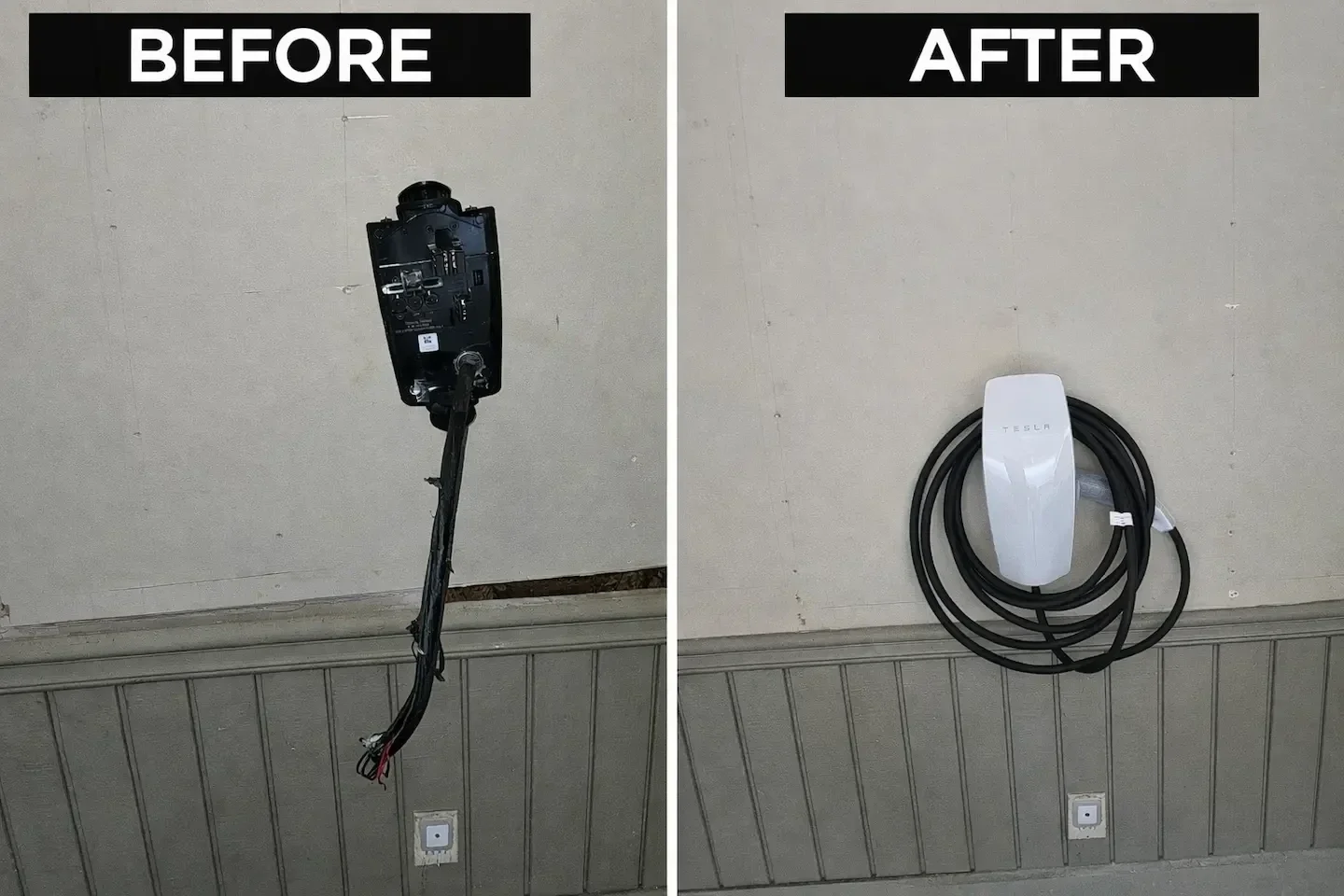
This Kia EV9 homeowner needed a clean Level 2 charging setup at home. Kais Pro Repairs installed a hardwired Tesla Wall Connector using #6 conductors and a 60-amp breaker. The before photo shows the rough charger wiring condition, and the after photo shows the completed Tesla Wall Connector mounted cleanly with the cable organized for everyday use.
This case study proves the main point of the blog: a Tesla charger can be used as part of a non-Tesla EV charging setup, but the installation has to be planned correctly. Connector compatibility, breaker size, conductor size, panel capacity, charger settings, and vehicle requirements all matter.
Tesla Wall Connector vs Tesla Universal Wall Connector vs Emporia
Here is the practical homeowner comparison before buying the wrong charger.
| Charger | Best For | Main Advantage | Main Concern |
|---|---|---|---|
| Tesla Wall Connector | Tesla vehicles, NACS-compatible vehicles, and some non-Tesla setups when compatibility is handled correctly | Clean Tesla ecosystem, strong app support, charging history, scheduling, and a polished wall-mounted look | For a J1772 non-Tesla EV, connector compatibility must be handled correctly |
| Tesla Universal Wall Connector | Homes with Tesla and non-Tesla EVs, or homeowners who want future flexibility | Supports both J1772 and NACS-style charging in one unit | Usually costs more than a basic single-connector charger |
| Emporia Classic | Homeowners who want a smart Level 2 charger with J1772 or NACS options | Good value, 25-foot cable, smart scheduling, energy tracking, and connector options | If the panel is tight, the circuit still needs careful load planning |
| Emporia Pro | Homes with limited panel capacity or homeowners who want smart load management | PowerSmart load management can adjust charging based on home energy use | More involved setup because it uses energy monitoring with the charger |
Pros and Cons of Using a Tesla Charger for a Non-Tesla EV
Pros
- Clean, professional-looking wall-mounted charger
- Strong Tesla app features for scheduling and charging history
- Good future fit if your next vehicle uses NACS/Tesla-style charging
- The Universal Wall Connector is a strong option for mixed Tesla and non-Tesla homes
- Can work well for a non-Tesla EV when compatibility and installation details are handled correctly
Cons
- A standard Tesla/NACS Wall Connector may not directly match every non-Tesla EV
- Adapters add another part to buy, store, and use correctly
- Not all adapters are equal; amperage rating and quality matter
- If you only own a J1772 EV, a J1772 charger may be simpler for daily use
- The charger still needs proper breaker sizing, conductor sizing, and panel capacity review
When a Tesla Universal Wall Connector Makes Sense
The Tesla Universal Wall Connector is a strong choice when you want one charger that can handle both Tesla and many non-Tesla vehicles. It is especially useful if your household has two EVs, one Tesla and one non-Tesla, or if you want future flexibility as more vehicles move toward NACS-style charging.
- You own a Tesla and another EV
- You may buy a Tesla or NACS vehicle later
- You want one clean wall-mounted charger instead of adapter clutter
- You like the Tesla app and charger design
- You want a future-friendly home charging setup
When Emporia Makes More Sense
Emporia is a strong choice when you want practical smart charging, good value, energy tracking, and a charger that can be purchased in the connector style that matches your vehicle. For many non-Tesla EV owners, Emporia is simple, affordable, and easy to live with every day.
- You currently drive a J1772 non-Tesla EV
- You want a 25-foot charging cable
- You want smart scheduling and energy tracking
- You want J1772 or NACS options
- Your panel may need smart load management
The Installer’s Recommendation
Choose the charger based on your vehicle, your panel, your charging habits, and how clean you want the daily experience to be.
You want maximum plug flexibility
Choose Tesla Universal Wall Connector if you have mixed vehicles, expect to switch vehicles, or want one charger that can serve Tesla and many non-Tesla vehicles cleanly.
You want smart energy value
Choose Emporia if you want practical smart charging, energy tracking, strong value, and a connector style that matches your EV. Emporia Pro is especially worth discussing when the panel capacity is tight.
You want a permanent high-output installation
A hardwired 60-amp circuit can support up to 48-amp charging when the equipment, conductor size, panel capacity, and installation method are correct.
Do Not Skip the Panel Check
A Level 2 EV charger can be one of the largest electrical loads in the home. A clean install starts with checking the panel, available capacity, breaker space, wire route, and charger setting.
- Panel size and available capacity
- Breaker space
- Conductor size and routing
- 50 amp vs 60 amp circuit planning
- Indoor or outdoor mounting location
- Vehicle charging limit
- Hardwired vs plug-in setup
Field Note From EV Charger Troubleshooting
When an EV charger powers on but faults after the vehicle is plugged in, the charger is only one possible cause. The issue can involve the vehicle, charger, breaker, ground fault protection, wiring, settings, or connector compatibility.
That is why a good EV charger installation is not just mounting a box. The circuit should be planned, installed, torqued, configured, and tested before the homeowner depends on it for daily charging.
EV Charger Questions Homeowners Ask
Can a Tesla Wall Connector charge a non-Tesla car?
Yes, depending on the charger version, vehicle connector, and adapter situation. A Tesla Universal Wall Connector is the cleaner choice for many mixed Tesla and non-Tesla homes because it supports both connector styles.
Can a Tesla Wall Connector charge a Kia EV9?
Yes, when connector compatibility and installation requirements are handled correctly. Kais Pro Repairs installed a hardwired Tesla Wall Connector for a Kia EV9 using #6 conductors and a 60-amp breaker.
Is a Tesla charger better than Emporia?
Not automatically. Tesla is a strong choice for Tesla owners, NACS vehicles, and mixed-vehicle homes using the Universal Wall Connector. Emporia is a strong choice for homeowners who want smart energy tracking, good value, J1772 or NACS options, and possible load-management features.
Can I use an adapter to charge a J1772 car from a Tesla-style charger?
In some cases, yes, but the adapter must be compatible and properly rated. For everyday home charging, many homeowners prefer a charger that matches the car directly or a Universal Wall Connector that avoids adapter hassle.
Do I need a 60 amp breaker for a home EV charger?
Not always. A 60 amp circuit is commonly used for up to 48 amp charging, but many vehicles and homes are better matched to a lower setting. The breaker, conductor size, charger setting, and vehicle limit must match.
Should I buy the charger before calling an electrician?
You can, but it is smarter to send photos of your panel and discuss the vehicle first. That helps avoid buying a charger that does not match your panel, connector needs, or installation plan.
Need Help Choosing or Installing an EV Charger?
Kais Pro Repairs installs Tesla Wall Connectors, Tesla Universal Wall Connectors, Emporia chargers, and Level 2 EV charger circuits for homeowners in Loganville and nearby areas. Send photos of your panel, charger, and vehicle information for a faster estimate.
Contact Kais Pro Repairs
Phone: 943-289-5667
Email: info@kaisprorepairs.com
Service Area: Loganville, Grayson, Snellville, Lawrenceville, Monroe, Gwinnett County, Walton County, and nearby areas.
Text This for a Faster EV Charger Estimate
- Vehicle make and model
- Charger brand you are considering
- Photo of your main electrical panel
- Photo of the panel label, if readable
- Garage or parking location
- Approximate distance from panel to charger location
- Whether you want a 50 amp or 60 amp setup